What Is the Difference Between a Goods Hoist, a Transport Platform and a Construction Hoist (Passenger and Goods Hoist)?
Three separate machine classes are used for vertical transport on construction sites and in industrial facilities, each governed by a different European standard: goods hoists (EN 12158), transport platforms (EN 16719) and passenger and goods hoists (EN 12159) — widely known in the industry as construction hoists, and also referred to as passenger and material hoists. Although these machines may look similar, they differ fundamentally in whether they may carry persons, how they are controlled and what equipment they require. Selecting the wrong machine creates both a safety risk and a compliance issue. This guide compares the three classes together with their international standard equivalents.
| Goods Hoist | Transport Platform | Passenger and Goods Hoist | |
|---|---|---|---|
| Standard (Europe) | EN 12158 | EN 16719 | EN 12159 |
| Standard (UK) | HSW Act, PUWER, LOLER, MHSWR, BS 7212, WHR | HSW Act, PUWER, LOLER, MHSWR, BS 7212, WHR | HSW Act, PUWER, LOLER, MHSWR, BS 7212, WHR |
| Standard (USA) | ANSI/ASSE A10.5 / OSHA | ANSI/SAIA A92.10 / OSHA | ANSI/ASSE A10.4 / OSHA |
| Standard (Canada) | CAN/CSA Z256-M87 | CAN/CSA B354.12-17, B354.13-17, B354.14-17 | CAN/CSA Z185-M87 |
| Carries persons | No | Up to 7 persons | Yes |
| Carries goods | Yes | Yes | Yes |
| Operation | From electrical controls at ground level or building floors | From electrical controls on the platform | From electrical controls in the cage or at landing levels |
| Control | Automatic or hold-to-run | From electrical controls on the platform | From electrical controls in the cage or at landing levels |
| Landing doors | Mandatory. Full or reduced height. Electrical and mechanical interlocking. | Mandatory. Full or reduced height. Electrical and mechanical interlocking. | Mandatory. Full or reduced height. Electrical and mechanical interlocking. |
| Cage enclosure | Mandatory. Electrical interlocking device. | Mandatory. Full height: electrical and mechanical interlocking. Low height: electrical interlocking. | Mandatory. Full height. Electrical and mechanical interlocking. |
| Car / Platform | Open top | Falling-object protection system | Fully enclosed |
What Is a Goods Hoist (EN 12158)?
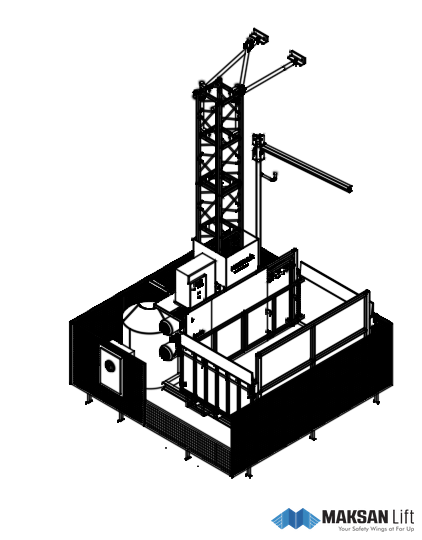
Goods hoist (EN 12158) — open-top car structure
A goods hoist is a vertical transport machine with an open-top platform, designed exclusively for carrying materials; persons are strictly prohibited from riding on it. The machine is operated from electrical controls at ground level or at building floors, either automatically or on the hold-to-run principle. Landing doors and a cage enclosure with an electrical interlocking device are mandatory.
What Is a Transport Platform (EN 16719)?
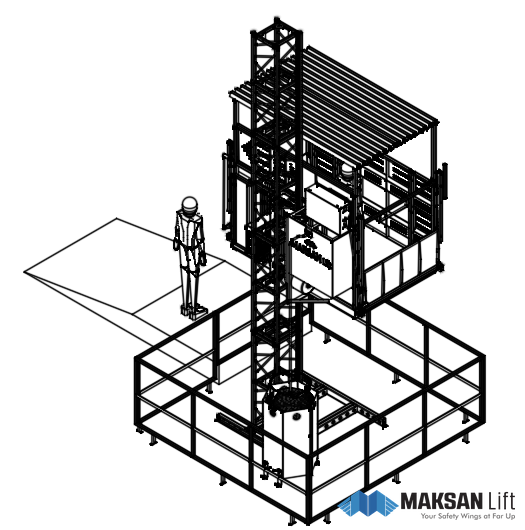
Personel ve yük asansörü (EN 12159) — kapalı kabin yapısı ve kat seviyeleri | dosya adı önerisi: personel-yuk-asansoru-en12159-teknik-cizim.png
Transport platform (EN 16719) — platform structure with falling-object protection A transport platform is the machine class in which up to 7 persons are permitted on the platform alongside the materials. It is operated from electrical controls on the platform and is fitted with a falling-object protection system. In practice, the same machine may be assessed in two configurations: a machine classed as a goods hoist (EN 12158) when open-topped can be used as a transport platform under EN 16719 once overhead protection is fitted.
What Is a Construction Hoist / Passenger and Goods Hoist (EN 12159)?
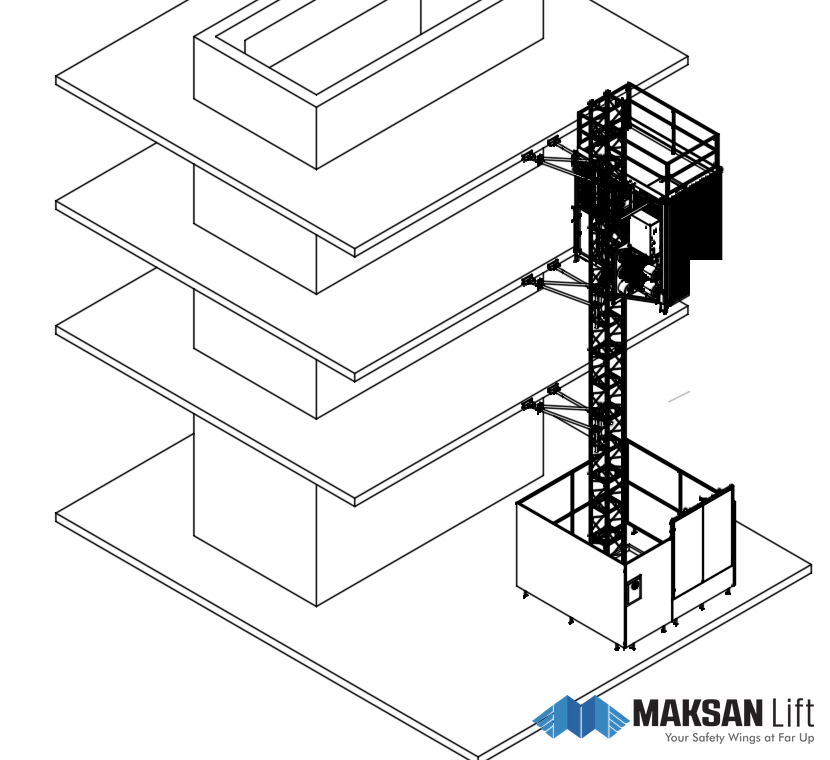
Passenger and goods hoist (EN 12159) — fully enclosed cage structure at building floors
A passenger and goods hoist — widely known as a construction hoist, and also called a passenger and material hoist — is the fully enclosed machine class that carries both persons and materials. It is operated from electrical controls in the cage or at landing levels; a full-height cage enclosure with electrical and mechanical interlocking, together with landing doors, is mandatory. Among the three classes, it is the only machine fully authorised to carry persons.
Which Machine Do I Need?
The choice follows what is being carried: materials only — a goods hoist (EN 12158); materials with only the operator riding — a transport platform (EN 16719); personnel and materials together — a passenger and goods hoist (EN 12159). For export projects, the standard equivalent in the destination country should also be verified — the table above lists the UK, US and Canadian equivalents.
For guidance on selecting the right machine and operator training, visit our Training Courses for Operators and Installers page or explore our product pages.
Frequently Asked Questions
Construction hoist is the common industry term for hoists erected on construction sites, most often referring to passenger and goods hoists under EN 12159 — also called passenger and material hoists. Goods-only hoists (EN 12158) and transport platforms (EN 16719) are sometimes loosely grouped under the same term, which is why checking the applicable standard is the safest way to identify the machine class.
A passenger and goods hoist (EN 12159) has a fully enclosed cage and may carry persons; a goods hoist (EN 12158) is open-topped and carries materials only — persons may not ride on it.
Yes — up to 7 persons, including the operator, may be on a transport platform (EN 16719). For transporting larger crews, a fully enclosed passenger and goods hoist (EN 12159) must be used.
The terms are sometimes confused, but these are different machines. Machines that provide vertical transport fall into the three classes in this guide; machines that provide a working platform along a façade are mast climbing work platforms (MCWP — EN 1495).

Request Form
Fields update based on your topic


Opening in November 2026
MAKSAN IPAF Training Centre
Pre-registration is now open for mast climbing work platform and construction hoist training. Participants who complete the course receive a PAL Card valid in more than 80 countries.